
The rise of artificial intelligence has changed the way people work, code and automate tasks. However, this progress has also opened the door to new digital threats. The phenomenon known as "hidden malware in AI agents" has become a real concern for individual users and companies alike.
More and more cybercriminals are taking advantage of the popularity of these tools to deceive users. To do so, they create fake pages that imitate legitimate AI assistants. At first glance, everything looks normal. Behind these supposedly intelligent solutions, however, hides malicious software designed to steal information.
Throughout this article we explain, in simple terms, how these attacks work, why they are so effective and what measures can help reduce the risks.
The growth of artificial intelligence agents
First, it is important to understand the context. AI agents have gained popularity because they promise to save time and improve productivity. They automate workflows, help with coding and deliver fast answers.
For that reason, many people search for these kinds of tools directly on the internet. The problem arises when the urgency to find quick solutions outweighs basic security precautions.
In addition, not every company allows or funds the use of these technologies. As a result, some employees decide to look for them on their own, unaware that they are stepping into dangerous territory.
How attackers take advantage of Google search
One of the methods most used by cybercriminals is search engine advertising. Suppose a user types phrases such as "download Claude Code" or "install coding assistant"; the first results are usually paid ads.
At first glance, these links look trustworthy. However, some of them lead to malicious pages that imitate official sites.
To increase their credibility, attackers use legitimate website-building platforms. This way, they manage to evade security filters and anti-phishing systems.
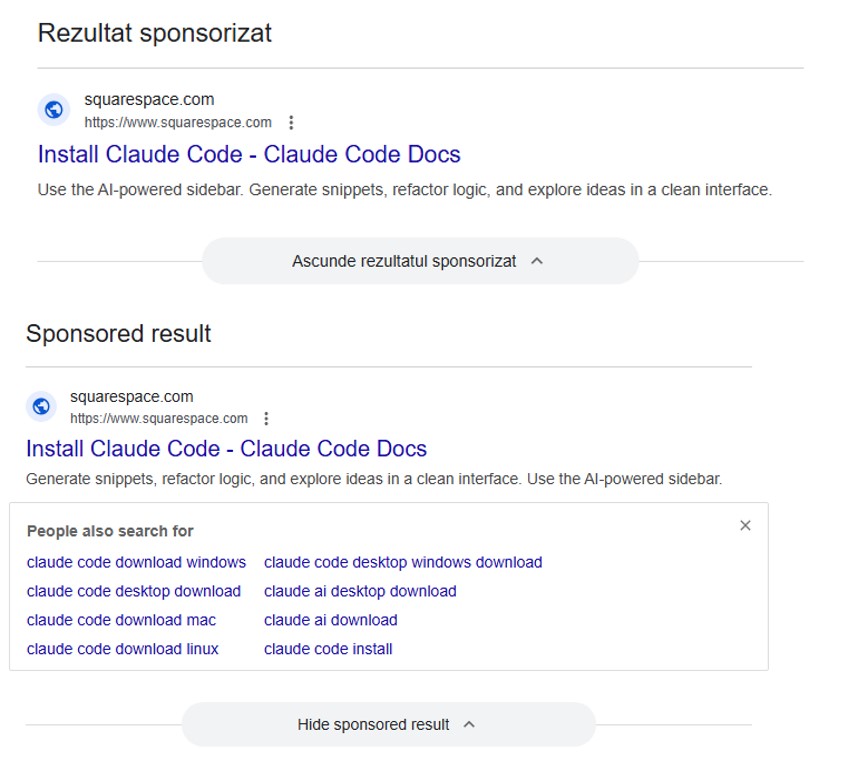
Search results with ads in Romania and Brazil
Fake pages that look real
Once the user lands on these sites, they find well-designed documentation. The content copies the visual style, the wording and the structure of the authentic pages.
They also include clear instructions to install the supposed AI agent. Typically, the user is asked to copy and run a command on their computer. This is the critical point of the deception.
Although the process looks technical and legitimate, no artificial intelligence tool is actually installed. Instead, a malicious program runs and infiltrates the system without the user noticing.

Website that replicates the installation instructions without authorization.

Official Claude Code page and installation.
A deception that adapts to the operating system
These attacks are not random. The criminals tailor the malware to the victim's operating system.
On macOS computers, the downloaded code installs spyware. This program is able to collect sensitive information without raising suspicion.
On Windows machines, on the other hand, the attack uses the system's own tools to run the malware. This makes it harder to detect and increases its effectiveness.
In this way, both home users and professionals are exposed to silent data theft.
What kind of information is at risk
The impact of these attacks goes beyond a simple infection. The installed malware can access different types of personal and corporate information.
The data that can be compromised includes:
- Information stored in web browsers
- Login credentials for digital accounts
- Personal files and work documents
- Data related to digital wallets
In corporate environments, the risk is even higher, since corporate secrets, source code and confidential data can be affected.
Why this type of attack is so dangerous
Unlike other, more obvious methods, these campaigns are built on trust. The user believes they are installing a modern, useful tool.
In addition, the use of terms such as "AI", "automation" or "smart assistant" lowers the perception of risk. The threat does not look like a traditional virus, but like an innovative solution.
As if that were not enough, the malware runs through actions that the user themselves authorizes. As a result, many security measures do not trigger immediately.
The impact on organizations
Companies are not exempt from this problem. In fact, they tend to be one of the main targets. When an employee installs malicious software on a corporate device, the entire network can be compromised.
This can lead to:
- Loss of strategic information
- Unauthorized access to internal systems
- Damage to the company's reputation
- High recovery costs
Given this landscape, education is key. Informing users about the risks associated with searching for and installing AI tools is the first step toward reducing incidents.
When people know the most common deception techniques, it is easier for them to spot warning signs. For example, suspicious ads or unusual instructions.
In addition, fostering a culture of security helps prevent impulsive decisions that can have serious consequences.
Best practices to reduce risk
Although there is no absolute protection, there are measures that can make a difference. The most important ones include:
- Download software only from official sites
- Avoid sponsored links when searching for a tool
- Check with the IT department before installing new programs
- Keep systems and applications up to date
Likewise, having reliable security solutions on every device is essential.
The role of corporate security
In the business environment, prevention must be a priority. Organizations can implement clear policies on the use of external tools.
It also helps to offer official, company-approved alternatives. This reduces the need for employees to look for solutions on their own.
On the other hand, ongoing cybersecurity training makes it possible to anticipate new threats and react more quickly.
Interest in AI agents keeps growing. Every new popular tool becomes a potential opportunity for attackers.
This means that malicious campaigns will keep evolving. The methods will become more sophisticated and harder to detect.
For that reason, constant vigilance and keeping knowledge up to date are essential to staying protected.
The concept of hidden malware in AI agents reflects a worrying reality in today's digital world. Technological innovation is advancing fast, but so are the threats.
Searching for artificial intelligence tools without the right precautions can put personal and corporate information at risk. What looks like a simple download can turn into an open door to data theft.
Ultimately, the best defense combines information, caution and the right security solutions. Only then will it be possible to take advantage of the benefits of AI without falling into the traps hidden behind its popularity.