In 2025, the use of generative artificial intelligence tools continued to grow around the world. More and more people are bringing these technologies into their everyday, professional and educational activities. That growth shows how AI has stopped being a novelty and become a resource available to millions of users.
International analyses indicate that roughly one in six people used some kind of generative AI tool during the second half of the year. The figure confirms steady progress and signals that the technology keeps expanding at a sustained pace.
How global AI adoption is measured
Global AI adoption is calculated from the actual use of products built on artificial intelligence. This measurement takes factors such as the following into account:
- Use of AI applications in different countries.
- Differences in internet access.
- Availability of modern devices.
- Variations in operating systems.
While no metric is perfect, these indicators make it possible to observe clear trends. Institutions dedicated to technology analysis keep refining their methodologies to better reflect how AI use is evolving in each region of the planet.
Uneven growth: the gap between the Global North and the Global South
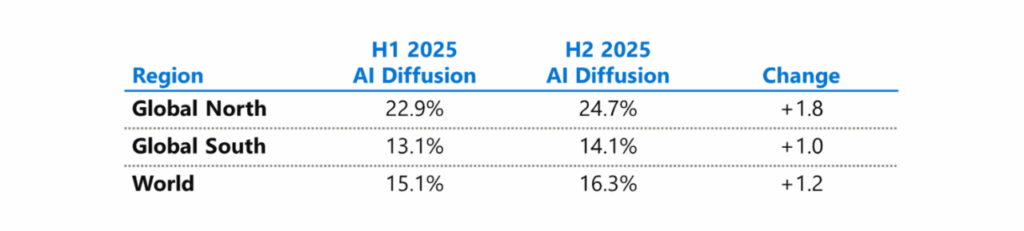
One of the most significant findings of 2025 is that AI adoption is not advancing at the same pace in every region. While growth is rapid in the Global North, it is moving more slowly in the Global South.
- In the most developed countries, close to a quarter of the working-age population uses these technologies.
- In regions with less digital infrastructure, the percentage is considerably lower.
This difference grows with every six-month period and points to an urgent challenge: making sure that technological innovation does not deepen existing inequalities.
The countries leading the way
Global leadership belongs to nations that bet early on digitalization. Among them:
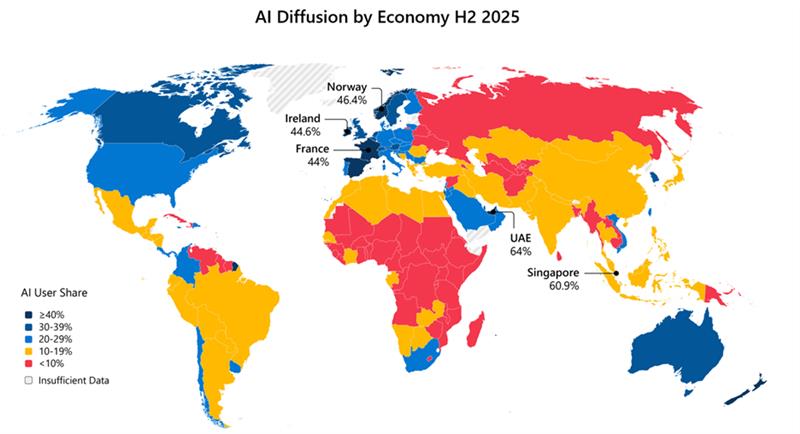
- The United Arab Emirates, which tops the list with adoption above 64%.
- Singapore, with more than 60% of its working-age population using AI.
- European countries such as Norway, Ireland, France and Spain, all with usage levels above the world average.
Their success comes down to public policy, investment in infrastructure and education programs aimed at building technology skills.
The case of the United States
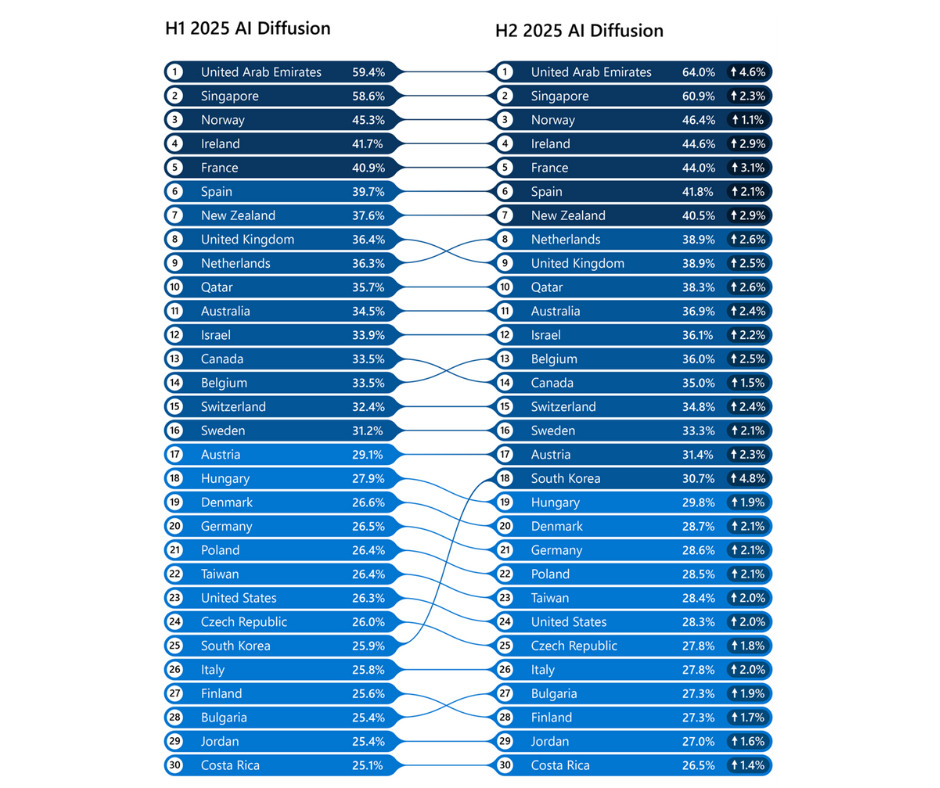
Although it leads in innovation, the United States presents a paradox. Despite its ability to develop advanced models and large-scale infrastructure, its population adopts AI at a slower pace than other, smaller economies. In 2025 it even slipped in the global ranking, overtaken by countries with more digitally engaged citizens.
South Korea: surprising growth
South Korea stands out among the most notable advances. In just a few months it climbed several positions thanks to:
- Government policies focused on technology.
- AI models adapted to the local language.
- Consumer-oriented tools available in schools and public services.
The country became one of the fastest-growing markets for AI-based conversational applications.
DeepSeek: the platform that transformed access to AI
Alongside this global growth, an unexpected phenomenon emerged: the expansion of DeepSeek, an open-source AI platform. Its approach simplified access to the technology because it:
- Offers its model under an open license.
- Lets anyone use a free chatbot with no barriers to entry.
- Positions itself especially in countries with less technology investment.
DeepSeek gained traction in traditionally underserved markets, including:
- China
- Russia
- Iran
- Cuba
- Belarus
But its most striking growth happened in Africa, where strategic partnerships drove adoption and gave communities with fewer resources access to advanced AI tools.
A global competition that goes beyond technology
The expansion of platforms like DeepSeek reveals a new dimension in the worldwide competition for leadership in artificial intelligence. The United States and China are no longer competing only to build more powerful models, but also to drive their use in strategic countries.
Open, free access has become a key tool for gaining presence in regions where the big technology companies had not managed to make significant inroads.
What 2026 could bring
Every sign suggests that AI adoption will keep growing, especially in regions where economic and technical barriers are coming down. If the trend continues, millions of new users could start using artificial intelligence for the first time in the coming months.
The global challenge will be to prevent this expansion from deepening the digital divide. The key will lie in promoting initiatives that allow more communities to benefit from innovation, rather than being left behind in a world increasingly driven by technology.