The pace of work has increased dramatically, overloading people with constant data, information, and communications. AI will make our work better by easing the burden of that pace, encouraging creativity, and unlocking productivity. Until now, AI has mostly operated on autopilot, but the new generation of copilots will work alongside people, freeing us from digital debt and unleashing creativity. Organizations that adopt AI will unlock productivity and increase value creation, as Satya Nadella, CEO of Microsoft, points out.
To prepare for this era, Microsoft surveyed 31,000 people in 31 countries and analyzed productivity signals from Microsoft 365 and LinkedIn. The data reveals three urgent insights that business leaders need to know as they adopt AI quickly and responsibly.
Three key points:
- Digital debt is holding back innovation.
- A new partnership between AI and employees is emerging.
- Every worker needs to master AI.
\1. Digital debt is holding back innovation.
We are overwhelmed by the volume of data, emails, meetings, and notifications, which exceeds our ability to manage it and accelerates the pace of work. Sixty-four percent of people lack the time and energy to do their job, which affects their ability to innovate and think strategically. In addition, 60% of leaders already notice a shortage of innovative ideas in their teams. Every minute spent managing digital debt is a minute lost to creative work. In a world where creativity is key to productivity, digital debt is hurting business.
The weight of the workday
Given how many working hours go to communication, 68% of people say they do not have enough uninterrupted focus time during the workday.
Sixty-eight percent of people say they do not have enough uninterrupted focus time during their workday.
Rising Hours Worked and a Longer Workday
Hours worked, the length of the workday, and time spent in meetings have increased steadily in recent years. It is easier than ever to communicate and harder than ever to keep up.
The Opportunity Cost of Lost Focus and Searching for Information
Looking more closely at how people spend their time, it is clear that the lack of time to focus, the search for information, and the volume of constant communications carry an opportunity cost. Sixty-eight percent of people say they do not have enough uninterrupted time to focus during the workday. And 62% of respondents say they struggle with spending too much time searching for information during their workday.
How Time Is Distributed in Microsoft 365
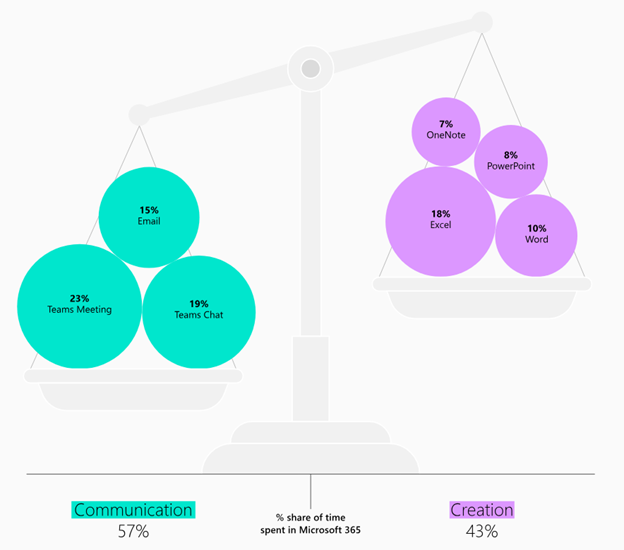
Across Microsoft 365 applications, the average employee spends 57% of their time communicating (in meetings, emails, and chats) and 43% creating (in documents, spreadsheets, and presentations). The heaviest email users (the top 25%) spend 8.8 hours a week on email, and the heaviest meeting users (the top 25%) spend 7.5 hours a week in meetings.
The Impact of AI on Knowledge Worker Productivity
This global average includes frontline workers. For knowledge workers, who depend even more on digital communication, the share of the week devoted to email and meetings is even higher. Artificial intelligence can tip the scales in people's favor so they can reclaim time and energy for the important work that drives innovation.
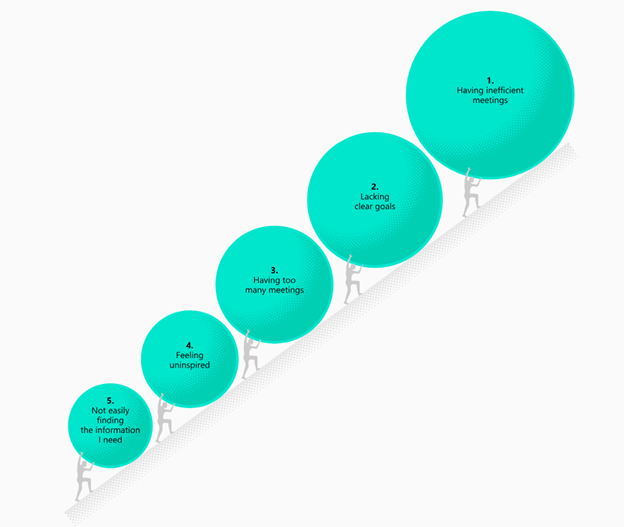
Take meetings as an example. People report that the main obstacle to productivity is inefficient meetings, followed closely by having too many meetings. Most say it is hard to brainstorm in a virtual meeting (58%) or to catch up if they joined late (57%), that the next steps at the end of a meeting are unclear (55%), and that it is hard to summarize what happened (56%). And since February 2020, people are in three times as many Teams meetings and calls per week (192%).
The data reveals the need to improve meetings, since only 35% of people believe they would be missed in most of them. The fear of missing out (FOMO) is real, and the main motivation for attending is to get information that improves their work. With AI, meetings become digital artifacts, making it possible to take part and interact synchronously or asynchronously, whichever is more convenient.
Take action:
- Detect and fix the factors that are hurting your organization's productivity using employee feedback.
- Radically redefine the workday. With AI freeing up time and energy, make sure you protect focus time for the creative work that leads to innovation.
- Think of meetings as digital artifacts, not just specific moments in time. Encourage people to use AI-powered intelligent meeting summaries, transcripts, and recordings so they can take part in the way and at the time that suits them best.
\2. A new partnership between AI and employees is emerging.
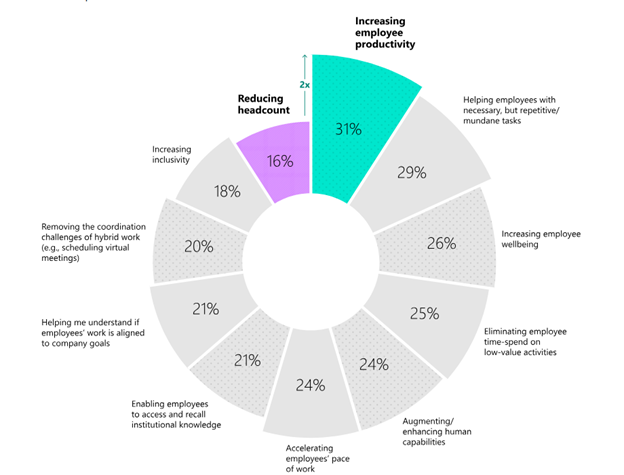
The data indicates that business leaders prefer to empower their employees with AI rather than replace them. According to what the chart shows, leaders value "increasing productivity" over "reducing headcount." After "increasing productivity," their main expectations for AI are: helping employees with repetitive tasks, improving employee well-being, eliminating low-value tasks, enhancing their capabilities, and accelerating the pace of work.
Work in 2030: What people want—and what AI can deliver
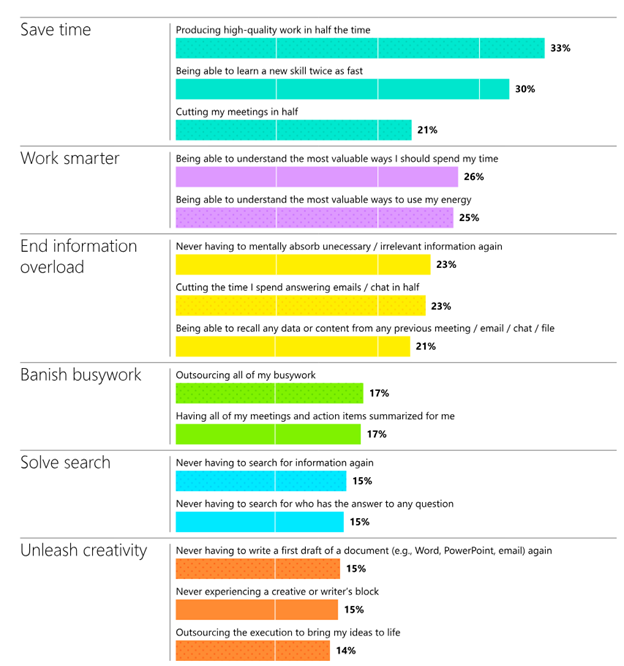
When asked to imagine work in 2030, survey respondents say they would place the most value on changes that save them time, such as producing high-quality work and learning new skills faster.
\3. Every worker needs to master AI.
The shift toward AI as a copilot requires a new way of working and the acquisition of new skills. Working with AI and using natural language will be as common as using the internet and computers is today. Skills such as critical thinking, complex problem solving, and creativity are now essential competencies, not only for technical roles.
Leaders believe it is crucial that employees learn when and how to use AI, write good prompts, evaluate creative work, and check for bias. As AI transforms work, collaboration between humans and AI will be a new trend, and the ability to work iteratively with AI will be fundamental for every employee.
New Skills for a New Way of Working
"Analytical judgment," "flexibility," and "emotional intelligence" top the list of skills that leaders consider essential for employees in an AI-powered future.
Learning is not keeping pace with work. Today, 60% of people say they do not have the right skills to do their job. AI will open new paths for learning, and success will depend on leaders equipping employees for an AI-powered future. AI will make our work better, and 82% of leaders say their employees will need new skills to be ready for the growth of AI.
We need to start building new skills today. On LinkedIn, there are 33 times more posts mentioning generative AI and GPT compared with last year. Karin Kimbrough, chief economist at LinkedIn, states that the introduction of generative AI is reshaping the labor market, creating new opportunities and roles, and increasing productivity. In March 2023, LinkedIn job postings mentioning GPT rose 79% compared with the previous year. In addition, 82% of leaders believe their employees will need new skills to be ready for the growth of AI.
Take action:
- Help people adopt a new way of working, starting with building AI skills, from practicing prompt engineering to verifying and fact-checking AI-generated content.
- Take advantage of learning resources and gather best practices from employees as they adapt to AI as a copilot.
- Consider how roles and functions can evolve alongside AI, creating opportunities for reinvention.
The road ahead
AI has the potential to ease the workload and foster innovation. Although employees and leaders are eager to increase productivity, AI will not simply "fix" work; it will create a new way of working. AI will make our work better, and leaders must help employees work responsibly with AI in order to get the most out of the partnership between AI and employees, which will result in greater value creation for companies and a brighter, more fulfilling future of work for everyone.