AI at work: operational impact is an increasingly common phrase in conversations about the future of business. Many organizations already use artificial intelligence every day. Yet real results are still slow to appear. The problem is usually not the technology. Today's models are powerful and capable. The real challenge lies in how work is organized. Processes are still designed for people who decide and coordinate every step. In that context, AI only helps; it does not transform.
A different kind of change is beginning today. Artificial intelligence is no longer limited to answering questions and is starting to carry out complete tasks. This step marks a new stage. A stage in which AI becomes an active part of daily operations.
From experimentation to real value
A lot of activity, little impact
In recent years, most companies have tried AI tools. They create drafts, launch pilots, and run internal tests. Even so, the cumulative impact tends to be low.
This happens because AI is used as occasional support. It answers emails. It summarizes texts. It generates ideas. Everything depends on a person starting and closing each action.
Meanwhile, the technology is already capable of much more. There are solutions that can plan tasks, execute them, and review results without constant supervision. The gap between what AI can do and what it actually does at work keeps growing.
The evolution of AI at work
From assistants to systems that act
For a long time, AI has been seen as an assistant. Its main function was to help a person work faster. That approach is now starting to fall short.
Tools such as GitHub Copilot, Claude Code from Anthropic and solutions described by OpenAI already point in another direction. These technologies do not just suggest; they also plan, run tests, fix errors, and improve results within a single workflow.
The shift is clear. AI is no longer a query layer. It becomes an operational layer.
What is an agentic work system?
A new way to organize work
An agentic work system is made up of several AI agents that collaborate with each other. Each one has a defined role. Together, they allow an objective to become a concrete result.
These systems do not work like a single tool. They work more like a well-coordinated team.
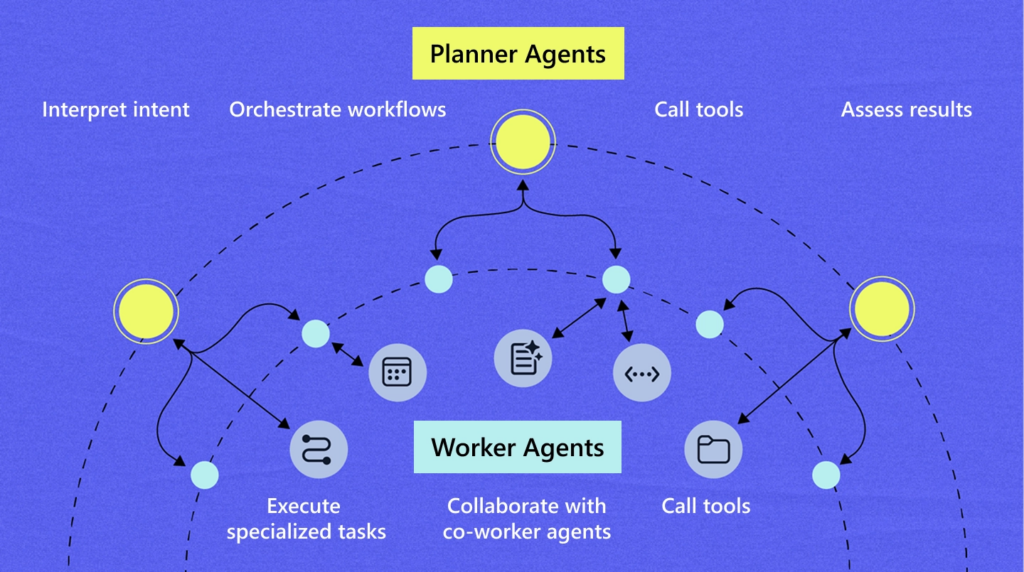
Key roles within the system
Planner agents
Planner agents receive a general objective. Their job is to break it down into clear steps. They decide what has to be done first and what can be executed in parallel.
They also assign each step to the right agent or to a specific tool. Then they review progress and decide what action comes next.
Worker agents
Worker agents are responsible for execution. They write code. They analyze data. They update information. They call tools when necessary.
Their value lies in precision and repeatability. They perform well-defined tasks over and over without losing consistency.
Constant coordination
The key is the interaction between the two types of agents. While some plan, others execute. If something fails, the system adjusts. If something works, it learns from it and reuses it in the future.
The importance of multi-step execution
Beyond isolated tasks
One of the major advances of these systems is the ability to stay focused over time. It is not about a single action. It is about completing an entire process from start to finish.
Practical examples can already be seen. A developer describes a change. The AI proposes a solution. It runs tests. It detects errors. It adjusts the result. All within the same working environment.
Although human supervision still exists, the direction is set. Multi-step execution will become the norm.
From support to operations
The real turning point
The biggest unlock in these systems happens when they move from one objective to the next without constant human intervention. At that moment, AI stops being an assistant and becomes part of operations.
Here an uncomfortable reality appears for many organizations. The stagnation is not due to a lack of technological capability. It is because processes are still designed for people to coordinate everything.
Until that changes, progress will remain incremental.
AI as a system, not as a tool
How a modern work system behaves
An agentic work system looks more like an organizational structure than an isolated application.
The process is clear:
- An objective comes in.
- The system translates it into tasks.
- Each task is assigned to the right agent.
- Results are evaluated against defined criteria.
- The system decides the next step.
- If something fails, it adjusts or asks for human support.
- If something works, it incorporates it as learning.
This approach makes it possible to scale results without losing control or quality.
The role of platforms such as Copilot
Toward coordinated execution
Solutions such as Microsoft Copilot are already evolving in this direction. The focus is shifting away from helping with isolated tasks. It moves toward coordinating complete workflows inside the tools people use every day.
This change does not happen all at once. It is gradual. But its impact is profound.
What this change means for leaders
A new kind of decision
The move from models that "know" to systems that "execute" is not only technical. It is organizational. It changes the way work is designed and managed.
Many leaders do not have a clear map of their workflows. This is normal. Processes have accumulated over time, across different teams and tools.
The common mistake is trying to redesign everything from scratch.
Where to start in practice
One workflow at a time
The most effective starting point is to choose a recurring outcome. It could be launching a campaign. Resolving a ticket. Closing a financial process. Then, observe how it is actually done.
A few key questions help identify opportunities:
- Where does work get delayed?
- Where do people step in only to unblock processes?
- Where does knowledge live inside someone's head?
Agentic work systems make these weak points visible. From there, workflows can be redesigned with real impact.
From theory to action
Fewer isolated experiments, more results
The value of this approach is not in running more AI tests. It is in turning AI into an operational mechanism.
When workflows are redesigned, results compound. Work moves forward with less friction. The organization gains speed and consistency.
The change does not happen all at once. It happens workflow by workflow.
Artificial intelligence in the workplace goes beyond simply adopting novel technologies. It is about transforming the structure and organization of work.
Artificial intelligence is already capable of planning, executing, and learning. The challenge now is to create systems that allow that capability to be used safely and consistently.
Organizations that understand this change will move from experimenting with AI to operating with it. And that difference will define the future of work.
The change does not happen all at once. It happens workflow by workflow.